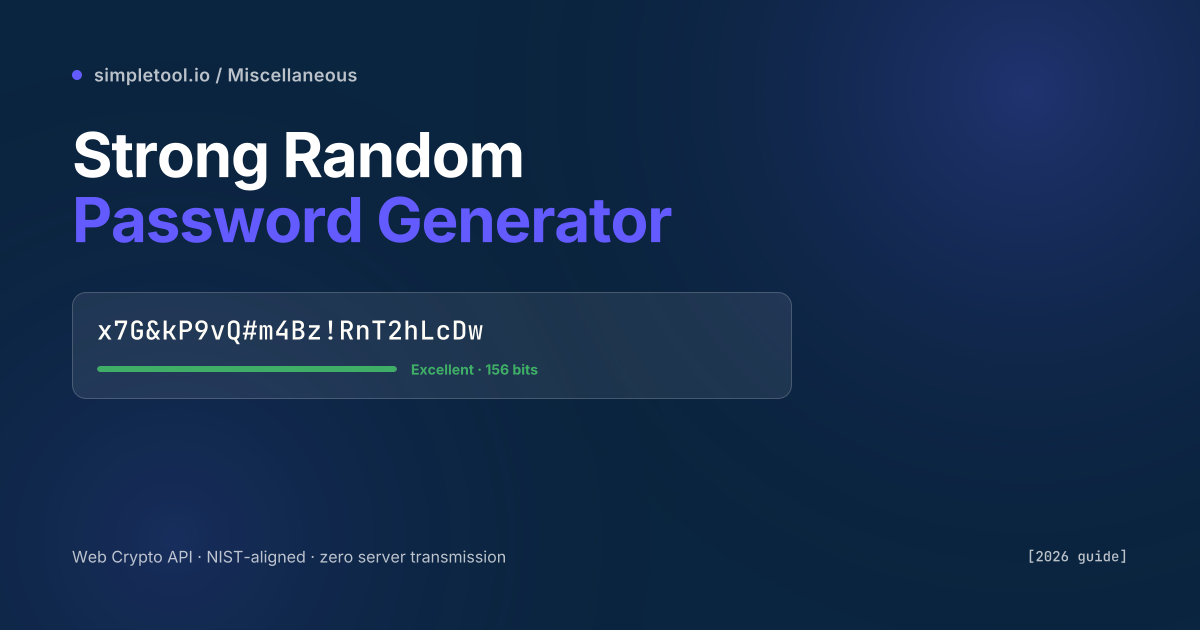
crypto.getRandomValues) to produce passwords from genuine OS-level entropy, not predictable Math.random(). Aim for at least 80 bits of entropy — that’s roughly 16 mixed-case alphanumeric characters or a 6-word passphrase. Our free generator does both and shows you the entropy live, so you can see exactly how strong each output is.The fundamental rule of password security has changed quietly: NIST’s 2024 update (SP 800-63-4) prohibits forcing users to mix uppercase, lowercase, digits, and symbols. The reason is empirical. Forced complexity rules produced more predictable passwords, not stronger ones — users picked the same dozen tricks (capitalise the first letter, replace o with 0, add ! at the end) and attackers learned them years ago. The new guidance: length is what matters. A 16-character lowercase-only password has more entropy than an 8-character password using the full ASCII set.
Our strong random password generator implements this guidance. It defaults to 20 characters with the full mixed-case alphanumeric+symbol pool, computes the entropy live, and runs entirely in your browser using the Web Crypto API — your password never travels to any server. This guide explains the math behind password strength, why Math.random() is dangerous, the three modes (random, pronounceable, passphrase) and when to use each, and the storage workflow that keeps strong passwords actually usable.
Why password entropy matters more than complexity
Password strength is measured in bits of entropy. A password with N bits of entropy means an attacker needs to try up to 2^N combinations to crack it by brute force. The math is simple: each character drawn at random from a pool of P characters contributes log₂(P) bits.
| Character pool | Pool size | Bits per character |
|---|---|---|
| Lowercase only (a-z) | 26 | 4.7 |
| Lower + upper (a-z, A-Z) | 52 | 5.7 |
| Lower + upper + digits | 62 | 5.95 |
| Lower + upper + digits + symbols | ~94 | 6.55 |
Multiply bits-per-character by length to get total entropy. The threshold to remember:
- Under 40 bits: weak. Crackable in minutes-to-hours by a modern GPU farm against any common password hash.
- 40-60 bits: moderate. Survives casual attacks but falls to determined attackers within days against fast hashes (MD5, SHA-256).
- 60-80 bits: strong. Beyond practical brute force for any single attacker; survives most state-of-the-art GPU farms for years.
- 80+ bits: excellent. Requires nation-state computational resources and decades of work. NIST’s recommended floor for high-security passwords.